How to Size a Condensing Unit for High-Ambient Conditions

Learn how to size a condensing unit for high-ambient conditions: choose the right design ambient, account for derating, and upsize the condenser. Read now.

TL;DR

Sizing a condensing unit for high-ambient conditions requires calculating your total heat load, selecting a design ambient temperature based on ASHRAE percentile data (not averages), and then checking the compressor’s actual capacity at that elevated condensing temperature. In regions where summer peaks exceed 40°C, a condensing unit rated at standard 35°C conditions can lose 14% to 40% of its capacity. The fix involves choosing the right design ambient, applying fouling and safety allowances, and often oversizing the condenser coil by one step to keep head pressure manageable.


In regions where summer ambient temperatures routinely exceed 40°C (104°F), a condensing unit sized for “standard” conditions will lose significant capacity, spike energy consumption, and may fail to hold temperature. This is the reality across much of South India, where Chennai summers push 42 to 44°C and inland areas of Rajasthan and central India reach 45 to 48°C. The Middle East regularly sees 50°C and above.


Proper sizing of a condensing unit for high-ambient conditions is not optional. It is the difference between a cold room that works year-round and one that struggles every summer. This guide walks through the terminology, the physics, and the practical steps that refrigeration technicians, engineers, and cold storage operators need.

What Is a Condensing Unit?

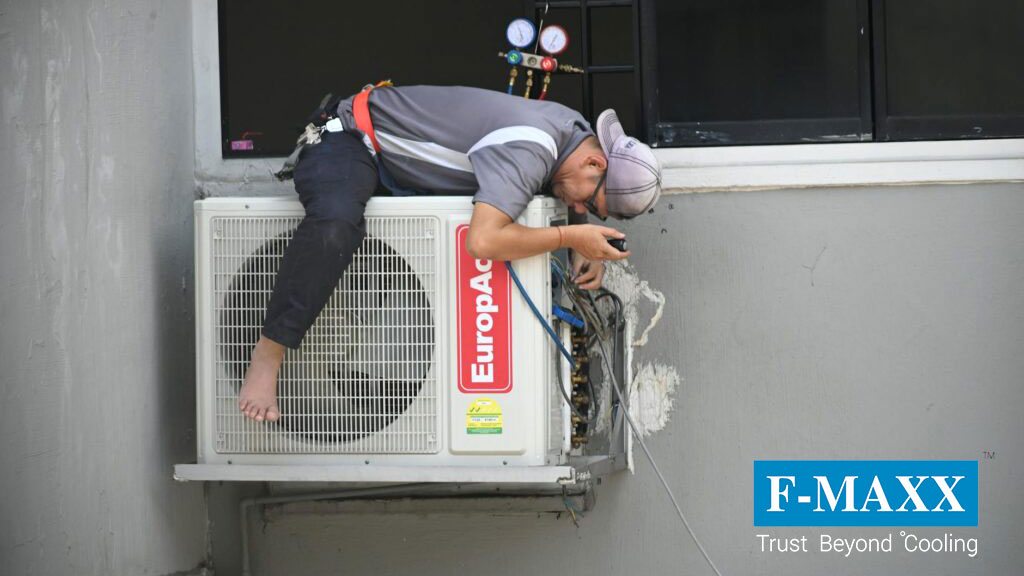
A condensing unit is a packaged assembly containing the compressor, condenser coil, and condenser fan. Its job is to reject heat from the refrigeration system to the outdoor environment. In an air-cooled unit, that heat goes into the surrounding air. In a water-cooled unit, it goes into a water circuit.


The condensing unit sits on the high-pressure side of the refrigeration cycle. The compressor raises the pressure (and temperature) of the refrigerant gas, then pushes it through the condenser coil. As outdoor air (or water) passes over the coil, it absorbs that heat, and the refrigerant condenses back into a liquid before returning to the expansion device and evaporator.


This heat rejection step is where ambient temperature becomes critical. The hotter the outdoor air, the harder it is to reject heat, and the worse the system performs. If you are evaluating refrigeration units for a cold storage project, understanding this relationship is the starting point.

What Counts as “High-Ambient”?

Any operating environment where outdoor dry-bulb temperatures routinely exceed 35°C (95°F) qualifies as high-ambient for refrigeration sizing purposes. Most manufacturers rate their condensing units at 35°C ambient. Once your site conditions exceed that number, you are in derating territory.


Here is what that looks like in practice across India:


  • Chennai: Summer peaks of 42 to 44°C

  • Inland Tamil Nadu / Coimbatore: 38 to 41°C

  • Rajasthan and Central India: 45 to 48°C

  • Middle East (for comparison): 50°C and above

But recorded air temperature is only part of the story. Practitioners on refrigeration forums consistently flag that rooftop or sun-exposed condenser placement effectively raises the ambient by 5 to 15°F beyond the recorded outdoor air temperature. A condenser sitting on a black tar roof in direct sunlight at a measured 42°C may be experiencing 48°C or more at the coil face. This makes physical placement a sizing factor, not just an installation detail.

Key Terms You Need to Know

Before walking through the sizing process, a few definitions are essential. These terms show up in manufacturer catalogs, engineering specs, and every conversation about how to size a condensing unit for high-ambient conditions.

Condenser Split (CTOA)

The condenser split, also called CTOA (Condensing Temperature Over Ambient), is the temperature difference between the ambient air and the condensing temperature of the refrigerant. For example, if the ambient is 95°F and the condensing temperature is 125°F, the split is 30°F.


This number varies by equipment efficiency. According to data from ACHR News, a standard-efficiency condenser normally runs a 25 to 30 degree split. High-efficiency units can run as low as 12 to 15°F. Bryan Orr of HVAC School puts it simply: “This will be 30° over ambient on VERY old units, all the way down to as low as 15° on new very high-efficiency units.”


Unit Efficiency Class

Typical CTOA Range

Standard efficiency (older units)

25 to 30°F (14 to 17°C)

Mid-efficiency

20 to 25°F (11 to 14°C)

High-efficiency (high SEER)

12 to 15°F (7 to 8°C)

Why this matters: CTOA determines your condensing temperature, which directly controls head pressure and compressor capacity. A lower CTOA means lower condensing pressure and better performance in hot weather.

Design Ambient Temperature

This is the outdoor temperature you use as the basis for equipment selection. ASHRAE publishes design conditions at 0.4%, 1%, and 2% exceedance levels, meaning the temperature exceeds the published value for that percentage of annual hours. The 0.4% value represents approximately 35 hours per year of exceedance, making it a conservative but practical choice for critical applications.


Using the average summer temperature for sizing is a common and costly mistake. An installation manager at a mortuary cooler company captured this well: “I always tell our clients to plan for the worst summer day, not the average. Those July heatwaves can push your equipment to the limit if you haven’t sized properly.”

Heat Load Components

The total heat load on your cold room determines how large the condensing unit needs to be. It breaks into four categories:


  • Transmission load: Heat flowing through walls, ceiling, and floor due to the temperature difference between inside and outside

  • Air infiltration load: Heat entering when doors open

  • Product load: Heat that must be removed from the stored product to bring it to target temperature

  • Supplemental loads: Heat from lights, fans, people, forklifts, and defrost cycles

For a detailed walkthrough of calculating these loads, the cold storage unit selection checklist covers each component.

Derating

Derating is the reduction in a condensing unit’s rated capacity when actual operating ambient exceeds the rated condition. Every degree above the rated ambient pushes condensing pressure higher, reducing the refrigerant mass flow rate through the compressor and cutting the net refrigerating effect. This is the central challenge when sizing for high-ambient conditions.

Safety Factor

Industry standard practice calls for a 5 to 10 percent safety factor on top of calculated refrigeration loads. This accounts for uncertainties in load estimation, minor variations in construction, and real-world operating conditions that deviate from design assumptions.

Compressor Run Hours

No compressor should run 24 hours a day. Copeland’s guidelines recommend 18 to 20 hour operation for no-defrost applications (where evaporating temperatures stay above 30°F/−1°C), 16 to 18 hours for medium-temperature applications with defrost, and 18 hours for low-temperature applications. The condensing unit must handle the full daily heat load within these run hours, not across a full 24-hour cycle.

Step-by-Step Sizing Process for High-Ambient Conditions

Here is the practical framework for sizing a condensing unit when your site ambient exceeds 35°C.

Step 1: Calculate Total Heat Load

Add up all four load components: transmission, air infiltration, product, and supplemental loads. This calculation is climate-sensitive from the start because transmission load is directly proportional to the temperature difference between outside and inside. A cold room holding −25°C in a 45°C environment faces a 70°C delta across the walls, compared to 60°C in a 35°C environment. That alone increases transmission load by roughly 17%.


If you are building a new facility, the cold storage warehouse requirements guide outlines the design parameters that feed into this calculation.

Step 2: Select Design Ambient Temperature

Pull the ASHRAE design data for your location, or use local meteorological records. For critical applications (pharmaceutical storage, blood banks, or any application where temperature excursions are unacceptable), use the 0.4% exceedance value. For commercial cold storage with product thermal mass that can buffer brief excursions, the 1% value is often acceptable.


Copeland’s engineering guidance makes an important point here: choosing the hottest possible temperature for a given region is not a recommended design strategy because extreme peaks may occur for very short durations and account for a tiny fraction of annual hours. The percentile approach balances reliability against oversizing.

Step 3: Add Fouling and Placement Allowance

It is typical to add 1 to 2°F to the design ambient conditions to account for condenser coil fouling over time. In dusty environments, cotton-growing regions, or installations near agricultural processing (common across South India), this allowance should be larger, perhaps 3 to 5°F.


For rooftop or sun-exposed installations, add an additional 5 to 10°F to account for radiant heat gain and restricted airflow. If the condenser is in an enclosed mechanical room, you may need to account for heat buildup there as well.

Step 4: Determine Target Condensing Temperature

Multiply your adjusted design ambient by the CTOA for your equipment’s efficiency class.


Example: Design ambient of 43°C (109°F) + 2°F fouling allowance = 111°F. With a standard-efficiency condenser (25°F CTOA), the target condensing temperature is 136°F. With a high-efficiency condenser (15°F CTOA), it drops to 126°F.


That 10°F difference in condensing temperature translates directly to lower head pressure, better compressor efficiency, and more capacity. This is why condenser efficiency class is a sizing decision, not just a cost decision.

Step 5: Apply Safety Factor

Add 5 to 10% to your calculated heat load. Resist the urge to pile safety factors on top of each other. Some engineers add a safety factor to the load, then pick a bigger compressor “just in case,” then oversize the condenser too. The result is a system that short-cycles, produces moisture problems, and wastes energy.

Step 6: Select Compressor Capacity at Design Conditions

This is where most mistakes happen. Manufacturers publish compressor capacity at rated conditions, typically 35°C ambient and a specific evaporating temperature. You need to look at the capacity tables or performance curves at your actual design condensing temperature, not the rated one.


For instance, a particular reciprocating condensing unit shows a 40% decrease in capacity from 85°F ambient to 110°F ambient, and a 14% decrease from 85°F to 95°F. If you select a unit based on its 85°F rating for a 110°F site, you will be short by 40%.

Step 7: Size the Condenser Coil

The condenser coil must reject the total heat of rejection (heat absorbed at the evaporator plus heat of compression) at your design temperature difference (TD). In high-ambient applications, going one size up on the condenser is common practice. Practitioners on Reddit’s r/refrigeration community consistently advise that “one size up for the condenser is normal. It accounts for hot weather and higher heat loads.”

Step 8: Verify with Manufacturer Data

Cross-check your selection against the manufacturer’s published capacity data at both your design evaporating temperature and your high condensing temperature. If the data only shows performance at 35°C ambient, request extended performance data or use the manufacturer’s selection software.

How Much Capacity Do You Lose in High-Ambient Conditions?

The capacity drop at elevated ambient temperatures is substantial and often underestimated. Here is what the data shows for two common compressor types at 20°F SST (suction saturated temperature):


Ambient Temperature Change

Reciprocating Condensing Unit

Scroll Condensing Unit

85°F → 95°F (29°C → 35°C)

~14% capacity loss

~9% capacity loss

85°F → 110°F (29°C → 43°C)

~40% capacity loss

~22% capacity loss

Source: Plumbing & HVAC Canada, data for 3.5 HP condensing units

One EPA-certified technician on Quora offered a useful rule of thumb: each 10°F rise above the 110°F target condensing temperature results in roughly a 19% reduction in capacity. While not universal across all compressor types, it gives a reasonable mental model for how quickly performance erodes.


The physics behind this degradation is straightforward. As the ambient temperature increases, less heat can be rejected from the air-cooled condenser. Therefore, more of the heat absorbed by the evaporator and suction line, as well as the heat of compression, will remain in the condenser. This raises head pressure, increases the compression ratio, and cuts refrigerant mass flow through the compressor.


Two practical implications follow from this:


Scroll compressors handle high ambient better than reciprocating units. The capacity curve is flatter, with only 22% loss at 110°F versus 40% for reciprocating units. For blast freezer systems and other low-temperature applications where compressor capacity is already constrained, this difference is significant.


Standard catalog ratings at 35°C are misleading for Indian installations. A unit rated at 10 kW capacity at 35°C ambient might only deliver 6 to 7 kW at 43°C. If your load calculation says you need 9 kW, that unit will not hold temperature during summer peaks.

Five High-Ambient Sizing Strategies That Work

1. Oversize the Condenser Coil

This is the single most effective and cost-efficient strategy. A larger condenser coil reduces the CTOA, which lowers condensing pressure, which restores compressor capacity. The Energy Trust of Oregon’s cold storage guide recommends installing an oversized condenser to decrease head pressure and improve compressor efficiency.


ACHR News frames the benefit well: “An oversized condenser means lower head pressure, and reduced electrical consumption. When the actual ambient is below the design ambient, we can take advantage of the now greater condenser capacity, allow the head pressure to fall, and start reaping the benefits.”

2. Use Scroll Compressors

As shown in the capacity tables above, scroll compressors lose less capacity at elevated ambient than reciprocating units. For high-ambient installations, this translates to a smaller oversizing margin needed and better year-round efficiency.

3. Choose the Right Refrigerant

Refrigerant choice affects high-ambient performance more than many engineers realize. A field study comparing R290 (propane) and R404A units in Phoenix, Arizona, across ambient conditions ranging from 60°F to 120°F found that R290 discharge temperatures were approximately 15°F lower and discharge pressures approximately 30% lower than R404A. The R290 units consumed 6.3% less energy on average. Lower discharge temperatures also mean less thermal stress on the compressor, a real longevity advantage in markets where ambient conditions push equipment hard.

4. Consider Water-Cooled Condensers

When air-cooled condenser capacity becomes marginal at extreme ambient temperatures, water-cooled systems maintain performance regardless of outdoor air temperature. The tradeoff is higher initial cost, water supply requirements, and more maintenance. But in locations consistently above 45°C, or where the condenser must be placed in an enclosed or poorly ventilated space, water-cooled condensers may be the only reliable option.

5. Implement Floating Head Pressure Control

Traditional systems maintain a fixed minimum head pressure year-round. Floating head pressure control allows the condensing pressure to drop when ambient temperatures are below design conditions (which is most of the year, even in hot climates). This captures significant energy savings during cooler hours, nights, and mild seasons, without compromising capacity during peak ambient conditions.

Common Sizing Mistakes in Hot Climates

Using catalog capacity at 35°C rated conditions for a 45°C+ site. This is the most frequent error. The catalog says the unit delivers X kilowatts, and the specifier matches that number to the calculated load. But at 45°C ambient, the actual delivered capacity could be 25 to 35% lower.


Ignoring radiant heat gain on rooftop or sun-exposed installations. The measured outdoor air temperature and the temperature the condenser actually sees can differ by 5 to 15°F. A condenser behind a parapet wall in direct afternoon sun is working in a micro-climate significantly hotter than the weather station reports.


Neglecting condenser fouling in dusty environments. Research from the ASHRAE RP-1705 study on air-cooled condensers found that a 50% reduction in condenser airflow caused significant performance degradation, while even a 10% reduction caused a 0.8% drop in capacity and 2% drop in efficiency. In dusty industrial areas, agricultural zones, and coastal environments with salt air, fouling accumulates fast.


Over-applying safety factors. Some specifiers stack safety margins: 10% on the load calculation, then round up to the next compressor size, then oversize the condenser. The result is a system that short-cycles, struggles to dehumidify, and wastes energy. Pick one reasonable safety factor (5 to 10%) and apply it once.


Not accounting for defrost cycle downtime. If your low-temperature system needs 6 hours of defrost time per day, the compressor has only 18 hours to handle the full daily load. Sizing based on 24-hour capacity will leave you short.

Air-Cooled vs. Water-Cooled: Which Is Better for High-Ambient?

Most cold storage installations in India use air-cooled condensing units because they are simpler, cheaper, and require no water supply. For ambient conditions up to about 42 to 44°C, a properly sized air-cooled unit with an oversized condenser coil works well.


Above 45°C, the math starts to shift. Air-cooled capacity drops sharply, energy consumption climbs, and compressor reliability becomes a concern as discharge temperatures push into the danger zone. Water-cooled condensers reject heat to water (typically via a cooling tower), and their performance is tied to wet-bulb temperature, not dry-bulb. In hot, dry climates, the wet-bulb temperature can be 10 to 15°C below the dry-bulb, giving water-cooled systems a massive advantage.


When to consider water-cooled:

  • Design ambient consistently exceeds 45°C dry-bulb

  • Condenser placement options are limited (enclosed rooms, restricted rooftops)

  • The refrigeration system is large enough to justify the additional infrastructure cost

  • Water supply is reliable and affordable

When air-cooled is the right choice:

  • Design ambient stays below 44°C with proper condenser placement

  • Budget or space constraints rule out cooling towers

  • The installation is a smaller walk-in cooler or freezer where simplicity matters

  • Water scarcity makes cooling tower operation impractical

For projects in South India where ambient conditions vary by season and location, consulting with a manufacturer who understands regional climate data can prevent expensive mistakes.

Why Insulation Quality Affects Condensing Unit Size

This is a connection that many sizing guides miss entirely. The insulation thickness and quality of your cold room panels directly determines the transmission heat load, which in turn determines how large a condensing unit you need.


In high-ambient conditions, this relationship becomes extreme. Consider a frozen storage room at −25°C in an area where summer ambient hits 45°C. The temperature difference across the wall is 70°C. With standard 100 mm PUF panels, the transmission load per square meter will be significantly higher than with 150 mm or 200 mm panels.


Better insulation means a lower transmission load, which means a smaller condensing unit, lower energy consumption, and more headroom during peak ambient conditions. The upfront cost of thicker panels is often recovered within one or two summers through reduced electricity bills and avoided equipment upsizing.


When evaluating panel options, the PUF vs PIR panel comparison covers the thermal performance differences between these two common insulation types. For a broader look at panel properties and how they affect cold room performance, the sandwich panel insulation properties guide provides detailed specifications.

The Product Thermal Mass Factor

One more factor worth noting: the thermal mass of stored product acts as a buffer during brief periods of above-design conditions. Greg Scrivener, writing in Plumbing & HVAC Canada, explains it well: “In a large box with a lot of product, it is normal to use that product to ‘flywheel’ through a period of above design conditions. In a cooler or freezer with a low product mass, like a blood sample cooler, the air temperature will rise quickly, and you need to be extremely careful.”


A fully loaded frozen warehouse at −25°C has enormous thermal inertia. Even if the condensing unit cannot keep up for a few hours during an extreme heat spike, the product temperature will barely move. An empty or lightly loaded cold room has no such buffer, and sizing must be more conservative.

Putting It All Together

Sizing a condensing unit for high-ambient conditions is not about applying a single correction factor. It is a chain of decisions: accurate heat load calculation, appropriate design ambient selection, honest assessment of installation conditions, and equipment selection based on actual (not rated) performance data.


For cold storage projects across South India and other high-ambient regions, these decisions directly affect operating cost, product safety, and equipment lifespan. If you are planning a new cold storage installation or upgrading an underperforming system, getting the condensing unit sizing right for your actual climate conditions is the most impactful engineering decision you will make. For project-specific guidance, the F-Max technical team can help evaluate your site conditions and recommend the right equipment configuration.

Frequently Asked Questions

Use the ASHRAE 0.4% or 1% annual exceedance value for your city, not the average summer temperature. For Chennai, this is approximately 39 to 41°C; for inland cities in Rajasthan, it can exceed 46°C. Then add 1 to 5°F for condenser fouling and any placement-related heat gain. Local meteorological data from IMD (India Meteorological Department) can supplement ASHRAE data for locations not listed in their handbook.

A flat 20% markup is a crude shorthand that sometimes undersizes and sometimes oversizes. The actual capacity loss depends on your specific ambient, the compressor type, and the refrigerant. A reciprocating unit loses roughly 40% capacity going from 85°F to 110°F ambient, while a scroll unit loses about 22%. The right approach is to check the manufacturer’s capacity data at your actual design condensing temperature rather than applying a generic percentage.

Monthly cleaning is a minimum for installations in dusty areas, near agricultural operations, or in coastal zones with salt air. Research shows that even a modest reduction in condenser airflow measurably reduces capacity and efficiency. In cotton-processing regions or areas with heavy particulate matter, bi-weekly cleaning may be necessary. Establish a cleaning schedule based on visual inspection during the first season of operation, then adjust.

Yes. Direct sunlight and radiant heat from surrounding surfaces can add 5 to 15°F to the effective ambient temperature at the condenser coil. A shade structure or strategic placement on the north side of a building (in the Northern Hemisphere) reduces this radiant gain. The shade structure must not restrict airflow, however. A condenser boxed into a tight enclosure with a shade roof can actually perform worse due to recirculation of hot discharge air.

This is a widely used diagnostic benchmark among HVAC technicians. For a standard-efficiency air-cooled condensing unit, the condensing temperature should be approximately 30°F above the ambient air temperature. If you measure a higher split, something is wrong: dirty coils, a failed condenser fan, airflow restriction, or an overcharged system. For newer high-efficiency units, the expected split drops to 15 to 20°F. This rule doubles as a quick field check after installation to verify your sizing assumptions are holding up.

R290 (propane) offers measurable advantages in high-ambient conditions: approximately 15°F lower discharge temperatures and 30% lower discharge pressures compared to R404A at operating conditions up to 120°F ambient. It also uses less energy, with field tests showing 6.3% lower consumption on average. The tradeoff is that R290 is flammable, which imposes charge limits and requires compliant equipment design. For new installations in high-ambient regions, R290 is increasingly the preferred choice where regulations and equipment availability permit.

Installation quality has a direct impact. Poor sealing of panel joints creates air infiltration that increases the heat load. Incorrect refrigerant charge, undersized suction lines, or excessive line lengths between the condensing unit and evaporator all degrade capacity. And as discussed throughout this guide, condenser placement in direct sun or enclosed spaces can effectively raise the ambient temperature by 5 to 15°F, turning a properly sized unit into an undersized one.

🌐 Get Online Quote at www.fmax.in/contact-us

📞 Call +91 94896 08022 to speak with our team.
Air- or Water-Cooled Condenser for Hot Ambients? (2026)

Should I choose air-cooled or water-cooled condenser for hot ambients? See efficiency, wet-bulb vs dry-bulb, water needs, and costs in our 2026 guide.

TL;DR

In hot ambients above 40°C, air-cooled condensers lose efficiency fast because condensing temperatures spike, forcing compressors to work much harder. Water-cooled condensers maintain lower, more stable condensing temperatures through wet-bulb-driven cooling towers, making them more energy efficient for large loads. But water availability, water quality, and your maintenance capability matter just as much as climate. The right choice depends on your specific region, budget, and operational reality, not a blanket rule.


Why This Question Matters More in Hot Climates

Condenser selection is straightforward in temperate climates. Pick air-cooled, save on complexity, move on. But when your facility sits in a region where summer ambient temperatures regularly cross 40°C or even 45°C, the stakes change completely.

The condenser is where your refrigeration system dumps heat. If it can’t reject heat efficiently, condensing temperatures climb, compressor power consumption balloons, and system reliability drops. Every degree Celsius of condensing temperature increase raises specific power consumption by roughly 3.5% source. On a 45°C day, that penalty adds up fast.


So when you ask “should I choose air-cooled or water-cooled condenser for hot ambients,” you’re really asking: how do I keep condensing temperatures low enough to protect my compressor, my energy bill, and my cold chain, given the climate I operate in?


This guide defines the key terms you’ll encounter during this decision, explains how Indian climate zones change the math, and gives you a practical decision matrix to work from. For a deeper technical comparison, see the detailed air-cooled vs water-cooled condensing unit guide.


Key Terms You Need to Understand

Before choosing between condenser types for hot ambients, get clear on the concepts that drive the decision. Each term below includes a plain definition and a note on why it matters when temperatures are extreme.

Condensing Temperature

The temperature at which refrigerant gas turns back into liquid inside the condenser. Lower condensing temperatures mean less compressor work and lower electricity bills. When the ambient environment is too hot, heat rejection slows down, condensing temperature rises, and the compressor has to push harder against higher system pressure source.


Why it matters in hot ambients: On a 45°C day with an air-cooled condenser, condensing temperatures can hit 56 to 62°C. At those levels, compressor power consumption can be 40 to 60% higher than at standard rating conditions.

Condenser Split (Approach Temperature)

The temperature difference between the condensing temperature and the cooling medium. For air-cooled condensers, the split is typically 11 to 17°C above ambient dry bulb temperature. For water-cooled condensers, it’s roughly 3°C above the cooling water temperature.


Why it matters in hot ambients: A smaller split means better efficiency. Water-cooled condensers achieve much tighter approaches, which is why they hold an efficiency advantage when ambient air temperatures are punishing.

Dry Bulb Temperature (DBT)

The standard air temperature reading from a thermometer, with no moisture correction. This is the number air-cooled condensers are slave to. When DBT reaches 45 to 48°C in Indian summers, air-cooled systems are operating at or beyond their design limits.

Wet Bulb Temperature (WBT)

The lowest temperature achievable through evaporative cooling. Water-cooled condensers (via cooling towers) and evaporative condensers operate against WBT, which is almost always lower than DBT source. The gap between DBT and WBT is called “wet bulb depression,” and it determines how much advantage water-based cooling provides.


Why it matters in hot ambients: In Rajasthan, the DBT might be 46°C while WBT is 28°C, a gap of 18°C. That’s a massive advantage for water-cooled systems. In coastal Chennai, the gap might only be 5 to 8°C. Same country, very different condenser economics.

COP (Coefficient of Performance)

The ratio of cooling output to energy input. Higher COP means more cooling per unit of electricity. Water-cooled systems typically achieve higher COP because they operate at lower condensing temperatures. But COP is a design-condition number. Real-world performance depends on how well the entire system (including the cooling tower) holds up under actual site conditions.

Tropicalised / Super Tropicalised

An Indian market term for condenser units designed and rated for high ambient operation. Blue Star, for example, markets “Super Tropicalised” semi-hermetic condensing units with internally grooved copper tubes for enhanced heat transfer and HP switches for optimal condensing pressure management source. F-Max similarly engineers condensing units for heavy ambients (up to approximately 65 to 75°C), using grooved copper tubes with aluminum fins and HP/LP cut-outs as standard.

Condenser Derating

The reduction in a condenser’s rated capacity when operating above its standard design ambient temperature. Manufacturers publish capacity tables at specific ambient conditions (often 35°C). If your site regularly sees 45°C, you need to derate the condenser’s nominal capacity, which usually means oversizing it.

Head Pressure / HP-LP Cut-out

Head pressure is the discharge-side pressure in the refrigeration system. When condensing temperatures rise, head pressure rises with them. HP/LP cut-outs are safety switches that shut down the compressor before dangerously high pressures cause damage. In hot ambients, systems without adequate condenser capacity will trip these safeties regularly, causing downtime and product temperature excursions.

The Three Condenser Types Compared

Most comparisons cover only two options. That’s incomplete. For hot ambient applications, the evaporative condenser deserves equal consideration.

Air-Cooled Condenser

Fans blow ambient air over finned coils containing hot refrigerant gas. The cooling medium is outdoor air, and performance is directly tied to dry bulb temperature.


  • Effective range: 10°C to 40°C ambient. Efficiency drops significantly above 40°C source.

  • Pros: No water needed, simpler installation, lower upfront cost, minimal maintenance (periodic coil cleaning).

  • Cons: Performance degrades sharply in extreme heat, needs large outdoor space, can be noisy.

  • Typical lifespan: 15 to 20 years source.

Water-Cooled Condenser

Refrigerant transfers heat to circulating water inside a shell-and-tube or plate heat exchanger. That water is then cooled by a cooling tower, which rejects heat through evaporation. Performance tracks wet bulb temperature.


  • Effective range: All ambient conditions, but the advantage over air-cooled is most dramatic above 40°C ambient.

  • Pros: Higher energy efficiency because water absorbs and transfers heat far more effectively than air source. More stable performance, quieter operation, longer equipment life.

  • Cons: Requires reliable water supply, ongoing water treatment, cooling tower maintenance. Initial cost is 20 to 40% higher than air-cooled. Legionella risk from poorly maintained cooling towers.

  • Typical lifespan: 20 to 30 years source.

Evaporative Condenser (The Third Option)

Combines air and water cooling. Water is sprayed over condenser coils while fans move air across them. Evaporation dramatically enhances heat rejection, and the system operates against wet bulb temperature like a water-cooled system, but without a separate cooling tower loop.


  • Best for: Very hot and dry climates where the wet bulb depression is large.

  • Key performance data from India: Evaporative condensers reduce compressor energy requirements by 15 to 20% compared to air-cooled equivalents in standard Indian operating conditions. When combined with subcooling heat exchangers, the cumulative energy reduction reaches 43% compared to baseline air-cooled systems source.

For operations planning a new cold storage facility, evaluating all three options, not just two, can significantly affect long-term operating cost.


How Ambient Temperature Affects Each Type

Here’s the critical physics that should drive your choice when deciding between air-cooled or water-cooled condensers for hot ambients.

Air-Cooled: The Math Gets Brutal

An air-cooled condenser operates at a condensing temperature equal to ambient DBT plus the condenser split (11 to 17°C). On a 35°C day, condensing temperature sits around 46 to 52°C. Manageable. On a 45°C day, it jumps to 56 to 62°C. That increase alone raises compressor power consumption by 35 to 50% compared to a moderate 30°C day.

Water-Cooled: Tied to the Wet Bulb

A water-cooled condenser operates at condensing temperature approximately equal to WBT plus cooling tower approach (3 to 8°C in practice) plus condenser approach (roughly 3°C). Even on a 45°C DBT day, if WBT is 28°C, condensing temperature stays around 34 to 39°C. That’s a 20°C+ advantage over air-cooled, translating directly to lower compressor work and lower electricity bills.

Temperature-Range Decision Table

Ambient DBT Range

Air-Cooled

Water-Cooled

Evaporative

Below 30°C

Works well, cost effective

Overkill for small systems

Unnecessary

30°C to 38°C

Acceptable with proper sizing

Efficient for larger loads

Good where water is available

38°C to 43°C

Needs oversizing, efficiency drops

Strong advantage

Strong advantage

Above 43°C

Significant derating, high energy penalty

Recommended for most applications

Best option in dry climates

The Indian Climate Factor: Why Generic Advice Fails

This is where most condenser selection guides fall short. They treat “hot climate” as a single condition. India has at least two very different hot climate profiles, and the right condenser choice differs between them.

Hot-Dry Zones (Rajasthan, Interior Tamil Nadu, Parts of Karnataka and Gujarat)

Peak DBT: 44 to 48°C. Peak WBT: 26 to 30°C. The wet bulb depression (gap between DBT and WBT) is large, often 15 to 20°C.

This is where water-cooled and evaporative condensers deliver their greatest advantage. Cooling towers perform well because dry air allows strong evaporation. If water is available, the choice is clear.

Hot-Humid Zones (Coastal Chennai, Mumbai, Kerala During Monsoon)

Peak DBT: 36 to 40°C. Peak WBT: 30 to 32°C source. The wet bulb depression shrinks to just 5 to 8°C.


Here, the advantage of water-cooled over air-cooled narrows considerably source. Cooling tower efficiency drops because humid air can’t absorb much more moisture. AAD Tech Group’s field analysis found that Indian cooling tower efficiency drops from roughly 70% in winter to as low as 52% during peak summer source. The cooling tower “approach” widens from a design-rated 3 to 4°C to a real-world 6 to 8°C, eroding the theoretical efficiency advantage.

Indian Water Quality Challenges

Water-cooled systems depend on cooling tower water quality. Indian borewell water typically contains 1,000 to 5,000 ppm TDS source, which creates aggressive scaling in cooling towers, especially in hot-dry zones where high evaporation rates concentrate minerals faster. Without a proper water treatment program, scale buildup degrades heat transfer and drives up energy consumption.


AAD Tech also documents a useful rule of thumb: for every 1°C increase in the cold water temperature supplied to the condenser (due to poor tower performance or scaling), a water-cooled system’s power consumption increases by approximately 3%.

Water Scarcity

Many Indian regions face acute water stress. Running a cooling tower that consumes thousands of liters per day may not be feasible or sustainable. In water-scarce areas, air-cooled condensers eliminate this dependency entirely, even if they cost more to operate in electricity.


When planning a new facility, these climate and infrastructure factors should be evaluated alongside the cold storage unit selection checklist to avoid costly mismatches.


Quick Decision Matrix

Use this table when deciding whether to choose air-cooled or water-cooled condenser for hot ambients at your specific site.

Factor

Favors Air-Cooled

Favors Water-Cooled

Consider Evaporative

Ambient regularly above 40°C

No (high energy penalty)

Yes

Yes (especially in dry zones)

Water scarce at site

Yes (no water needed)

No

No (uses water)

Poor water quality / high TDS

Yes

No (scaling risk)

No (scaling risk)

High humidity (coastal)

Moderate penalty

Reduced advantage

Reduced advantage

Budget constrained

Yes (lower upfront cost)

No (20 to 40% more)

No (higher complexity)

Large capacity above 50 TR

Energy penalty grows

Yes

Yes

Limited maintenance team

Yes (minimal upkeep)

No (water treatment required)

No (needs regular attention)

Noise restrictions (urban, hotel)

No (fans are loud)

Yes (quieter)

Moderate

Long equipment life priority

15 to 20 years

20 to 30 years

20 to 25 years

A Surprising Finding: Air-Cooled May Cost Less Overall

The assumption that water-cooled is always cheaper to operate is not absolute. An IIAR study simulating ammonia warehouse systems across six US cities found that air-cooled systems used only 0 to 8% more energy than evaporative systems, with the highest penalty in very dry climates. When water costs, treatment chemicals, and cooling tower maintenance were factored in, air-cooled systems showed net total operating cost savings of 4 to 20% across all locations studied source.


ARANER’s case study from Amman (a hot-dry climate comparable to parts of interior India) found that the water-cooled advantage shrank significantly during off-design hours (nighttime, cooler periods). Shifting operation to cooler hours using thermal storage made the air-cooled system’s extra electricity consumption “negligible” source.


The takeaway: total cost of ownership, not just energy efficiency on the hottest day of the year, should drive your decision.


Common Mistakes When Choosing a Condenser for Hot Ambients

1. Picking air-cooled for above 40°C ambient without oversizing.
Catalog ratings assume standard ambient conditions. If you don’t derate the condenser for your actual peak temperatures, you’ll face chronic high head pressure, frequent HP cut-out trips, and reduced cooling capacity right when you need it most.


2. Choosing water-cooled without budgeting for water treatment and tower maintenance.
The condenser itself may run great, but a neglected cooling tower with scale-clogged fill and fouled nozzles will wipe out the efficiency advantage within a year. Budget for chemical treatment, regular cleaning, and water makeup costs.


3. Ignoring evaporative condensers as an option.
Many buyers default to the air vs. water binary. For Indian cold storage applications in hot-dry zones, evaporative condensers can deliver 15 to 20% energy savings over air-cooled with less water consumption and complexity than a full water-cooled loop.


4. Using catalog ratings without derating for local design conditions.
A condenser rated at 35°C ambient and 95°F condensing temperature will not deliver that performance in Nagpur at 46°C. Always ask the manufacturer for derated capacity at your site’s design ambient.


5. Neglecting condenser coil cleaning schedules.
Dirty coils increase the condenser split, raising condensing temperature and energy bills. This is especially critical for air-cooled condensers in dusty industrial environments. A regular coil cleaning program is cheap insurance. Good insulation also reduces total heat load on the condenser, so evaluating your PUF panel specification is part of the same efficiency equation.


6. Not accounting for installation space and airflow.
Air-cooled condensers need ample open space with unobstructed airflow. Placing them in enclosed machine rooms or against walls causes hot air recirculation, effectively raising the ambient temperature the condenser sees by 5 to 10°C. This is a common and entirely avoidable installation error. The cold room installation guide covers placement considerations in detail.


Making the Right Choice for Your Facility

The question of whether to choose air-cooled or water-cooled condenser for hot ambients doesn’t have a universal answer. It depends on your climate zone, water availability, system capacity, maintenance capability, and budget.

Here’s a practical summary:


  • Hot-dry zone, water available, large system: Water-cooled or evaporative condenser. The efficiency gains will pay back the higher initial investment.

  • Hot-humid zone, moderate system size: Air-cooled with oversizing, or water-cooled if you have treated water. The water-cooled advantage is smaller here.

  • Water-scarce area, any climate: Air-cooled is your best option. Oversize the condenser, keep coils clean, and run during cooler hours when possible.

  • Small to medium system, budget priority: Air-cooled with tropicalised ratings. The upfront savings and low maintenance requirements often outweigh the energy penalty for smaller loads.

F-Max manufactures both air-cooled and water-cooled condensing units designed for Indian ambient conditions, with grooved copper tubes, aluminum fins, and HP/LP safety cut-outs as standard features. For a site-specific recommendation based on your climate zone and application, contact the engineering team directly.


For buyers in cold chain planning mode, the cold-chain warehouse planning guide provides broader context on how condenser choice fits into overall facility design.

Frequently Asked Questions

Air-cooled condensers work effectively up to about 40°C ambient. Above that, condensing temperatures rise steeply (to 56 to 62°C at 45°C ambient), causing significant compressor power penalties. They can still function above 40°C if properly oversized and rated for high ambients, but the energy cost increases by roughly 3.5% for every additional degree of condensing temperature.

It depends on the wet bulb depression at your location. In hot-dry climates where the gap between dry bulb and wet bulb temperatures is 15 to 20°C, water-cooled systems can operate at condensing temperatures 20°C lower than air-cooled equivalents. In hot-humid coastal areas, the advantage narrows to 5 to 10°C because wet bulb temperatures are closer to dry bulb temperatures.

An evaporative condenser sprays water over refrigerant-carrying coils while fans move air across them. Evaporation dramatically improves heat rejection. They’re most effective in hot-dry climates and can reduce compressor energy by 15 to 20% compared to air-cooled condensers. Combined with subcooling, savings can reach 43% according to Indian cold storage field data.

Yes, significantly. Indian borewell water often contains 1,000 to 5,000 ppm TDS, which causes rapid scaling in cooling towers and heat exchangers. Scale buildup insulates heat transfer surfaces, raising condensing temperatures and energy consumption. A proper water treatment program with chemical dosing, blowdown management, and regular cleaning is essential.

Not always. While water-cooled systems are more energy efficient on the hottest days, total operating cost includes water consumption, water treatment chemicals, cooling tower maintenance, and potential Legionella management. An IIAR study found that when these costs were included, air-cooled systems showed 4 to 20% total operating cost savings across multiple climate zones.

Tropicalised (or super tropicalised) refers to condensing units specifically designed and rated for high ambient temperatures common in tropical countries like India. These units typically feature enhanced heat transfer surfaces (like grooved copper tubes), larger condenser coils, and safety mechanisms such as HP/LP cut-outs to handle elevated operating pressures.

Start with the manufacturer’s capacity data at your site’s design ambient temperature, not the catalog’s standard rating conditions. If the catalog rates at 35°C and your site hits 45°C regularly, you need to request derated capacity figures and size accordingly. Many installations underperform because the condenser was selected based on optimistic ambient assumptions. Using a structured cold storage selection checklist helps catch these oversights early.

It’s possible but involves more than just swapping the condenser. You’ll need to add a cooling tower, water piping, water treatment system, and potentially modify the refrigerant circuit. The mechanical room layout changes, and ongoing water management costs begin. For existing systems in hot ambients, improving air-cooled performance through coil cleaning, shade structures, fan upgrades, or misting systems is often more practical than a full conversion.

🌐 Get Online Quote at www.fmax.in/contact-us

📞 Call +91 94896 08022 to speak with our team.
Air Cooled vs Water Cooled Condensing Unit: 2026 Pros & Cons

Compare efficiency and costs in the air cooled vs water cooled condensing unit choice. Get 2026-ready insights and selection tips to pick the right system.

When comparing an air cooled vs water cooled condensing unit, the right choice depends entirely on your priorities. For large-scale industrial applications, water-cooled units deliver superior energy efficiency and more stable performance. However, air-cooled systems offer a simpler, more cost-effective solution with a lower upfront investment, making them ideal for smaller operations or in regions where water is scarce. This decision will impact everything from your budget to your monthly electricity bills, especially in the demanding climate of South India.


This guide breaks down the comparison across key factors like efficiency, cost, and maintenance to help you determine which technology is the smart, informed choice for your business.

What is an Air Cooled Condensing Unit?

An air cooled condensing unit is a refrigeration component that uses the surrounding air to cool down and condense hot refrigerant gas back into a liquid. Think of the outdoor unit of a typical home air conditioner. A large fan blows ambient air across a series of finned coils containing the hot refrigerant, transferring the heat from the refrigerant into the atmosphere.

These units are popular because they are self contained. They don’t require any water hookups or complex plumbing, which makes installation simpler and keeps the initial cost down. This simplicity makes them a common choice for smaller applications like residential AC, walk in coolers, and businesses where water is either unavailable or expensive.

What is a Water Cooled Condensing Unit?

A water cooled condensing unit uses water instead of air as its cooling medium. In these systems, the hot refrigerant gas passes through a heat exchanger (often a shell and tube or plate type) where it transfers its heat to circulating water. This heated water is then pumped to an external device, usually a cooling tower, to release the heat.


Because water is much better at absorbing and transporting heat than air, water cooled units are incredibly efficient. This makes them the go to choice for large scale commercial and industrial applications like food processing plants, high rise buildings, and large cold storage warehouses where high capacity and energy efficiency are top priorities.

Cooling Medium and Method: Air vs. Water

The fundamental difference in the air cooled vs water cooled condensing unit debate comes down to the cooling medium and the method used to reject heat.

    • Cooling Medium: This is the substance that carries heat away from the refrigerant. For an air cooled system, the medium is air. For a water cooled system, it’s water. Water has far superior thermal properties; it can absorb and remove much more heat per unit of volume compared to air. In fact, air has relatively poor thermophysical properties as a coolant, which is why air cooled systems need larger surfaces and more airflow to do the same job.

    • Cooling Method: This describes how heat is rejected. Air cooled units use a direct or “dry” cooling method. Water cooled systems typically use an “evaporative” cooling method. The water that absorbs heat in the condenser is cooled in a cooling tower, where a small portion evaporates, dramatically cooling the rest of the water. This evaporative process is the secret to their high efficiency.

Performance in the Real World: Temperature and Stability

How a unit performs on the hottest day of the year is a critical consideration, especially for businesses in regions like Tamil Nadu or Andhra Pradesh.

Condensing Temperature: The Key to Efficiency

Condensing temperature is the temperature at which the refrigerant turns from a gas to a liquid. The lower this temperature, the less work the compressor has to do, which means lower energy consumption.

    • Air Cooled: The condensing temperature is directly tied to the ambient (dry bulb) air temperature. For heat to transfer effectively, the refrigerant must be significantly hotter than the air, often around 11 to 17 °C (20 to 30 °F) higher. So on a 35 °C day, the condensing temperature might be as high as 46 to 52 °C, forcing the system to work very hard.

    • Water Cooled: The condensing temperature is linked to the wet bulb temperature of the air, which is the lowest temperature that can be reached through evaporation. The wet bulb temperature is almost always lower than the dry bulb temperature. This allows a cooling tower to produce cool water even on a hot day, resulting in a much lower and more stable condensing temperature for the system.

Performance Stability Across Conditions

Because of their reliance on ambient air, the performance of air cooled systems can fluctuate significantly with the weather. Their cooling capacity drops and their energy use spikes on very hot days.


Water cooled units offer far more stable and consistent performance. Since they rely on the more stable wet bulb temperature, they are less affected by daily temperature swings, ensuring reliable cooling capacity when you need it most, like during peak summer heatwaves. For critical applications like pharmaceutical storage, blast freezing, or food processing, this stability is a massive advantage.

The Bottom Line: Initial Cost vs. Operating Costs

Your budget is always a key factor. Here’s how the two options stack up financially.

Upfront Investment (Initial Cost)

Generally, air cooled systems have a lower initial cost. They are simpler, packaged units that don’t require the extra equipment and complex installation that water cooled systems do.


A water cooled system requires a cooling tower, water pumps, extensive piping, and water treatment equipment, all of which add to the upfront price. The initial capital cost for a water cooled system can be 20% to 40% higher than an air cooled system of the same capacity.

Long Term Expenses (Operating Costs)

This is where water cooled systems shine. Thanks to their superior efficiency, water cooled units have significantly lower operating costs, driven primarily by lower electricity consumption. They can consume roughly half the energy of a comparable air cooled unit to produce the same amount of cooling. Over the lifespan of the equipment, these energy savings can be substantial. One study showed a 200 ton water cooled system saving about $20,000 per year in electricity, paying back its higher initial cost in just a few years.


However, water cooled systems do have other operating costs to consider, namely water consumption from the cooling tower and the cost of water treatment chemicals. For most large applications, the energy savings far outweigh these additional costs.


At F-Max Systems, we help our clients analyze these trade offs to find the most cost effective solution for their specific needs. Get a customized cost analysis for your project from F-Max Systems.

Practical Considerations: Installation, Space, and Upkeep

Beyond performance and cost, you need to consider the practical logistics of installing and maintaining your system—including the quality of PUF panels and insulated doors that determine overall insulation performance.

Installation and Space Requirements

    • Air Cooled: Installation is relatively simple. The unit is placed outdoors on a roof or pad, connected to power and the refrigerant lines. However, the units themselves are physically larger and require significant open space for proper airflow.

    • Water Cooled: Installation is more complex, requiring skilled technicians to install the condensing unit, cooling tower, pumps, and all the associated water piping. While the condensing unit itself is often more compact, the entire system requires both indoor mechanical room space and outdoor space for the cooling tower.

Maintenance Needs

    • Air Cooled: Maintenance is straightforward. The main task is regularly cleaning the condenser coils to remove dust and debris, which can hinder airflow and reduce efficiency (see our guide on preventive maintenance of cold rooms).

    • Water Cooled: Maintenance is more involved. It requires a consistent water treatment program to prevent scale, corrosion, and biological growth like algae. The cooling tower also needs periodic cleaning, and the condenser tubes may need to be brushed clean annually to maintain peak performance. While more demanding, a well maintained water cooled unit often has a longer lifespan, potentially lasting 25 years or more compared to about 15 years for an air cooled unit.

Key Factors You Can’t Ignore

A few more critical factors can influence your decision in the air cooled vs water cooled condensing unit debate.

Water Availability and Consumption

This is a non negotiable point. Water cooled systems continuously consume water through evaporation. If your facility is in an area with scarce, expensive, or unreliable water, an air cooled system is the practical choice, as it uses zero water.

Noise Levels

Air cooled units are generally louder due to the large fans needed to move massive volumes of air. Water cooled systems tend to be much quieter, as the condenser is often located indoors and the cooling tower, while it has a fan, can be placed away from noise sensitive areas.

Environmental Impact

There’s a trade off here.

    • Water Cooled systems are more energy efficient, which means a smaller carbon footprint from electricity generation. However, they consume significant amounts of water.

    • Air Cooled systems conserve water but use more electricity, leading to higher indirect greenhouse gas emissions.

Air Cooled vs Water Cooled Condensing Unit: How to Choose

The best choice depends entirely on your specific circumstances. There is no single right answer. Here are the key selection criteria to weigh:

    • Climate: In very hot climates, the efficiency and stability of water cooled systems are a major advantage.

    • Initial Budget: If upfront capital is tight, the lower initial cost of an air cooled system is attractive.

    • Operating Costs: For large systems with high run hours, the long term energy savings from a water cooled unit often provide the best return on investment.

    • Water Availability: If water is scarce or expensive, an air cooled unit is the clear winner.

    • Space: Consider your available indoor and outdoor space. Do you have a spot for a cooling tower or a large open area for an air cooled unit?

    • Maintenance Capability: Be realistic about your team’s ability to handle the water treatment and maintenance required for a water cooled system.

Making this decision requires careful consideration of all these factors. For a deeper dive into facility planning, see our cold-chain warehouse guide. Consulting with experienced refrigeration professionals can provide clarity and ensure you select a system that delivers reliable performance and value for years to come.


The team at F-Max Systems specializes in designing and manufacturing refrigeration solutions engineered for the tough conditions of South India. Reach out to us today to discuss your project and get an expert recommendation tailored to your needs.

Frequently Asked Questions

Neither is universally “better”. The best choice depends on your specific application, climate, budget, and local resources. Water cooled units are more efficient and stable in hot climates for large loads, while air cooled units are simpler, cheaper upfront, and ideal for smaller applications or where water is limited.Neither is universally “better”. The best choice depends on your specific application, climate, budget, and local resources. Water cooled units are more efficient and stable in hot climates for large loads, while air cooled units are simpler, cheaper upfront, and ideal for smaller applications or where water is limited.

Yes, water cooled systems have a higher initial cost, typically 20% to 40% more than air cooled systems. This is due to the need for additional equipment like a cooling tower, pumps, and piping. However, their lower energy consumption often makes them cheaper to run over their lifespan.

Water cooled systems are significantly more energy efficient. They can often produce the same amount of cooling while consuming about half the energy of a comparable air cooled system.

No, air cooled condensing units use zero water for their operation. Their independence from water is a major advantage in regions with water scarcity.

The biggest disadvantage is that its efficiency and cooling capacity decrease significantly as the outdoor air temperature rises. On very hot days, they have to work much harder, which increases energy consumption and can strain the equipment.

It is not recommended. Water cooled systems rely on a continuous supply of make up water for the cooling tower to function. In water scarce areas, an air cooled vs water cooled condensing unit comparison heavily favors the air cooled option.

🌐 Get Online Quote at www.fmax.in/contact-us

📞 Call +91 94896 08022 to speak with our team.